
Snappywords - Puzzles & Word Games - Futoshiki Puzzle
Futoshiki, also known as "More or Less", is a logic puzzle played on a rectangular grid. The goal is to fill the grid with numbers so that each number appears only once per row and column—similar to Sudoku. The twist: inequality signs such as “<” or “>” are placed between some cells and must also be respected.

By combining logic, elimination, and comparison, you gradually work your way toward the correct solution. As the grid size increases, so does the level of difficulty—and the satisfaction when you solve it.

5 Tips for Solving Futoshiki Successfully

1. Start with the obvious numbers

If a row or column has already excluded several numbers, look for positions where only one number logically fits.

2. Pay close attention to the inequality signs

A “<” between two cells means the left cell must be smaller than the right one. These clues often give you strong constraints for certain values.

3. Use the process of Elimination

If a number logically cannot go in a certain cell (due to conflicts in the row, column, or with an inequality sign), eliminate it mentally or visually.

4. Work step by step from certain to uncertain

Start with cells where you’re completely sure. These solid anchors will help you logically solve the more complex parts later.

5. Stay patient with larger grids

In 6x6 or 7x7 puzzles, letters (e.g., A = 10, B = 11) appear after number 9. Don’t let this confuse you—the logic stays the same.

More games

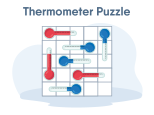
In the Thermometer Puzzle, you logically fill cells so that the number per row and column matches the given clues.

Play now
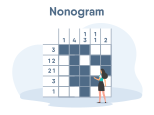
In Nonograms, you fill in grid cells based on numerical clues to logically reveal a hidden picture step by step.

Play now
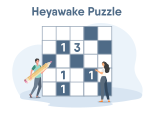
In Heyawake, fill cells black or white, follow region numbers, connectivity, and restrictions to logically solve the puzzle step by step.

Play now
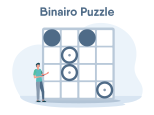
In Binairo, you fill a grid with black and white circles - ensuring equal distribution, no three identical in a row, and unique rows and columns.

Play now
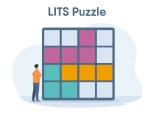
In LITS, you place tetromino shapes in marked regions, avoiding touching identical pieces and 2×2 blocks – all filled cells must form one connected area.

Play now

In Hashi, you connect numbered islands with bridges to form a single network - no crossings allowed, with the correct number and a maximum of two bridges per connection.

Play now

We value your opinion

Do you feel there's something we can add or improve? Are there features missing that you'd like to have? Perhaps you have suggestions for how we can make this site better for you? We're always grateful for your input.