
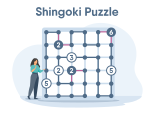
Slant, also known as “Gokigen Naname,” is a logic puzzle played on a rectangular grid. The goal is to draw a diagonal line in every cell—either from the top left to the bottom right, or from the top right to the bottom left.

At the intersections of the grid lines, numbers from 0 to 4 may appear. These indicate how many diagonal lines meet at that point. The second important rule: the lines must not form a closed loop anywhere in the puzzle.

By combining clues, eliminating impossible options, and checking line directions, you work step by step toward the correct solution. Larger grids increase the challenge—and the satisfaction of solving.

5 Tips for Successful Slant

1. Start with certain number clues

A “0” means no lines can meet at that point, while a “4” means all must meet there.

2. Watch for the loop rule

Even if a line matches the number clues, it cannot be placed if it would complete a closed loop.

3. Use the process of elimination

If one diagonal would create a loop, the other diagonal must be correct.

4. Work from simple to complex

Solve the cells with only one possible option first, then tackle trickier sections.

5. Check your progress frequently

Small mistakes can have big consequences—regularly verify that all lines match the given clues.

More games

Connect dots into a single closed loop – go straight through white circles, turn at black ones, and follow the number clues for correct line lengths.

Play now
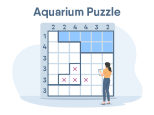
In Aquarium, you fill grid cells based on edge numbers, ensuring each tank has a constant water level to logically reach the solution.

Play now

Fill the grid with numbers – each appearing once per row and column – while following all greater/less-than clues between adjacent cells.

Play now
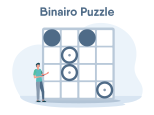
In Binairo, you fill a grid with black and white circles - ensuring equal distribution, no three identical in a row, and unique rows and columns.

Play now

In Hashi, you connect numbered islands with bridges to form a single network - no crossings allowed, with the correct number and a maximum of two bridges per connection.

Play now
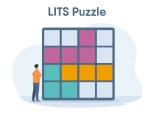
In LITS, you place tetromino shapes in marked regions, avoiding touching identical pieces and 2×2 blocks – all filled cells must form one connected area.

Play now

We value your opinion

Do you feel there's something we can add or improve? Are there features missing that you'd like to have? Perhaps you have suggestions for how we can make this site better for you? We're always grateful for your input.